





Improving Efficiency: Batteries and Pure Sine Wave Inverters
- Understanding Power Conversion Basics
- What is an inverter and why waveform matters
- Where losses occur: batteries to AC plug
- Why I focus on car inverter pure sine wave for vehicle installs
- Choosing the Right Battery for High-Efficiency Systems
- Battery chemistry trade-offs
- Practical battery efficiency metrics I measure
- Why BMS and thermal management are non-negotiable
- Optimizing Pure Sine Wave Inverters for Vehicle and Off-grid Use
- Inverter efficiency and real-world performance
- Car inverter pure sine wave specifics: installation and derating
- Waveform, THD and sensitive equipment
- Integration, Testing, and Real-World Performance
- System matching: inverter, battery and alternator
- Monitoring and measurement: what I test
- Example performance comparison
- Advanced Tactics: Extending Runtime and Improving Efficiency
- Smart charging strategies
- Load scheduling and power management
- Cooling, mounting and maintenance
- Why Choose a Proven Manufacturer: Guangzhou Congsin Electronic Technology Co., Ltd.
- Congsin’s experience and product focus
- Manufacturing capability and compliance
- Product range and services
- References and Standards I Use When Certifying Systems
- Technical standards and guidance
- Frequently Asked Questions (FAQ)
- 1. Is a pure sine wave inverter necessary for my car or RV?
- 2. How much efficiency gain can I expect by switching from lead–acid to LiFePO4?
- 3. My inverter states 95% efficiency—why do I get less runtime?
- 4. What are the best practices for wiring a car inverter pure sine wave to minimize losses?
- 5. How do I verify an inverter’s waveform quality and THD?
- 6. Can I use a car inverter pure sine wave with solar and alternator charging?
I write from long experience designing and testing DC→AC systems for vehicles, RVs and off-grid applications. In this article I explain how batteries and pure sine wave inverters interact to determine usable energy, losses and reliability. You will learn how the choice of battery chemistry, inverter topology (including car inverter pure sine wave models), battery management systems (BMS), and installation details affect end-to-end system efficiency and the real run-time you can expect from a portable power solution or vehicle power inverter installation.
Understanding Power Conversion Basics
What is an inverter and why waveform matters
An inverter converts DC to AC. A pure sine wave inverter produces a smooth sinusoidal AC output closely matching mains power and is essential for sensitive electronics, efficient motor operation and lower harmonic distortion. By contrast, modified sine wave inverters approximate the waveform and can cause extra heating, noise and reduced efficiency in many loads. For an authoritative overview of inverter concepts and typical efficiencies, see the general inverter reference on Wikipedia.
Where losses occur: batteries to AC plug
Losses occur at each stage: battery internal resistance (I^2R losses during discharge), DC cabling and connections, inverter conversion loss, and the inefficiency of the load (device). Improving overall system efficiency requires reducing losses at every stage; sometimes a modest improvement in individual components yields a large gain in usable runtime.
Why I focus on car inverter pure sine wave for vehicle installs
In vehicles and RVs, space and battery capacity are constrained. Using a high-quality car inverter pure sine wave unit lets devices draw power efficiently and reduces heat-related derating. Because vehicle alternators, BMS setups and cabling often create higher system impedance than home installs, waveform purity and inverter control strategies (e.g., ECO modes, soft-start) materially affect usable energy.
Choosing the Right Battery for High-Efficiency Systems
Battery chemistry trade-offs
Choosing the proper battery chemistry is the first lever for efficiency and lifecycle cost. Below I summarize practical differences that I use when advising customers:
| Chemistry | Typical Energy Density (Wh/kg) | Cycle Life (typical) | Depth of Discharge (DoD) | Notes |
|---|---|---|---|---|
| Lead–acid (flooded / AGM) | ~30–50 | 200–700 | ~50% | Low upfront cost, heavy, high self-discharge. See Lead–acid — Wikipedia. |
| Lithium-ion (NMC, NCA) | ~150–260 | 500–2000+ | 80–100% | Higher energy density and efficiency; requires BMS for safety. See Lithium-ion — Wikipedia. |
| LiFePO4 | ~90–160 | 2000–5000+ | 80–100% | Excellent cycle life and thermal stability for vehicle/RV/off-grid use. See LiFePO4 — Wikipedia. |
Sources above are reputable encyclopedic summaries; when selecting cells or packs I always check manufacturer datasheets for precise energy density, charge/discharge curves and C-rate limits.
Practical battery efficiency metrics I measure
When I test systems I track coulombic efficiency (charge in vs. charge out), round-trip energy efficiency (useful Wh out / Wh in) and effective run-time under realistic loads (including inverter losses). Lithium chemistries typically show 90–98% coulombic efficiency and 85–95% round-trip for battery packs when charged using correct profiles and BMS. Lead–acid systems commonly yield lower round-trip efficiency (70–85%) depending on depth of discharge and charge algorithm.
Why BMS and thermal management are non-negotiable
A properly configured Battery Management System (BMS) prevents over-charge/over-discharge, balances cells and often includes temperature compensation. Especially for car inverter pure sine wave applications where alternator charging and regenerative loads are common, the BMS keeps cells within safe voltages and extends usable capacity. Thermal management (ventilation, mounting away from heat sources) preserves efficiency because battery internal resistance increases with temperature extremes.
Optimizing Pure Sine Wave Inverters for Vehicle and Off-grid Use
Inverter efficiency and real-world performance
Modern pure sine wave inverters can reach peak efficiencies in the 90–95% range under optimal loads, but small-load efficiency and behavior under variable loads differ by design. I recommend reviewing the inverter's efficiency curve (often provided in datasheets) to ensure the inverter operates near its peak efficiency for your expected load. The U.S. Department of Energy provides general guidance on inverter role and performance in solar systems: DOE — Solar Power Inverters.
Car inverter pure sine wave specifics: installation and derating
Vehicle installations introduce additional constraints: alternator voltage fluctuations, long DC runs, and limited cooling. To maximize efficiency I apply these rules:
- Size the inverter for typical continuous load rather than peak—oversized inverters run inefficiently at low loads.
- Use appropriately gauged DC cabling and short runs to minimize I^2R losses.
- Choose inverters with low idle consumption (standby losses) for intermittent use.
- Consider inverter features such as intelligent ECO mode, soft-start for inductive loads and built-in monitoring to keep systems in efficient operating windows.
Waveform, THD and sensitive equipment
Pure sine wave car inverters produce low total harmonic distortion (THD), typically <3% for quality units; this protects active power supplies, audio systems and motors. Poor waveform can increase losses in inductive loads and reduce efficiency; documentation and independent test reports should list THD, crest factor and peak power behavior.
Integration, Testing, and Real-World Performance
System matching: inverter, battery and alternator
I always emphasize system-level thinking. A high-efficiency inverter paired with an undersized alternator or improper charging profile will underperform. For vehicle systems, ensure the alternator or DC-DC charger can supply the required charging current and that the BMS permits the intended charge profile (especially for LiFePO4 packs). For DC→AC conversions, confirm that the inverter's input voltage window matches your battery bank.
Monitoring and measurement: what I test
To prove efficiency gains I measure:
- Battery state-of-charge (SoC) over a discharge cycle using a calibrated coulomb counter.
- Inverter input and output power with an accurate power meter to compute conversion efficiency at multiple loads.
- Thermal readings at battery, inverter and cabling to identify hotspots that indicate losses.
Example performance comparison
Below is a representative table I use when advising clients: it compares a typical car inverter pure sine wave to a modified sine wave inverter under a 600 W resistive load, based on aggregated datasheet figures and independent reviews.
| Metric | Pure Sine Wave Inverter (Quality Unit) | Modified Sine Wave Inverter |
|---|---|---|
| Peak Efficiency | ~90–95% (at optimal load) | ~80–90% (often lower with non-linear loads) |
| Idle/Standby Loss | Low (varies 0.5–3 W in ECO) | Often higher, and may have more switching noise |
| THD | <3% (good units) | High; not suitable for sensitive electronics |
| Suitability for motors/UPS | Excellent | Poor to fair |
These representative numbers are consistent with manufacturer datasheets and inverter engineering notes; always consult the specific model's documentation for precise performance curves.
Advanced Tactics: Extending Runtime and Improving Efficiency
Smart charging strategies
Charging strategy influences round-trip efficiency. For lithium chemistries I favor multi-stage charging with a BMS-controlled end-of-charge taper. For vehicle systems with DC-DC chargers, I recommend adjustable charge profiles so the alternator or source operates near its peak efficiency while avoiding overheat and wasted parasitic losses.
Load scheduling and power management
Scheduling heavy loads to run when charging is available (e.g., engine running, solar peak) reduces net battery cycling. Integrating an energy monitor and using ECO or remote-on features of a car inverter pure sine wave unit yields better overall system energy use and longer battery life.
Cooling, mounting and maintenance
Proper airflow around the inverter and batteries prevents thermal derating. I recommend routine inspection of terminals, torque on connections, and using anti-corrosion protectants in marine/vehicle environments. These simple measures preserve low resistance paths and maintain efficiency over years.
Why Choose a Proven Manufacturer: Guangzhou Congsin Electronic Technology Co., Ltd.
Congsin’s experience and product focus
For customers who want factory-backed reliability, I often recommend evaluating manufacturers with a long track record. Guangzhou Congsin Electronic Technology Co., Ltd., founded in early 1998, is a professional power inverter manufacturer with over 27 years of focused experience. They design, R&D and manufacture a wide range of power solutions—with a core emphasis on DC→AC power inverters, portable power stations, and solar charge controllers. Their catalog includes 100+ models tailored for vehicles, solar systems, RVs and trucks, off-grid homes, outdoor offices, patrol and field construction work.
Manufacturing capability and compliance
Congsin operates fully automated production lines, advanced instrumentation and multifunctional testing equipment to ensure product reliability, efficiency and intelligent functionality. Their quality system is ISO9001 certified (ISO9001 — ISO) and many products hold international approvals such as CE, EMC, LVD, ETL, FCC, RoHS and E-MARK. Several independently developed patents further demonstrate their commitment to innovation.
Product range and services
Congsin’s products serve global markets across Europe, the Americas, the Middle East, Africa and Southeast Asia; many models are supplied to domestic and international OEM channels. Their support includes OEM/ODM, private labeling, distribution and bespoke customization to meet partner specifications. Key product areas include Solar Charge Controller, modified sine wave inverter, pure sine wave inverter and portable power stations—making them a one-stop partner for integrated vehicle and off-grid power solutions.
References and Standards I Use When Certifying Systems
Technical standards and guidance
- IEEE standards relevant to inverter interconnection and performance are authoritative for grid-tied and safety-related features; see IEEE Standards Association listings, e.g., IEEE 1547 (interconnection).
- U.S. Department of Energy articles on inverters and power electronics provide practical context for inverter roles in distributed energy systems: DOE — Solar Power Inverters.
- Battery chemistry details and basic metrics are often summarized in authoritative references like Lithium-ion — Wikipedia and Lead–acid — Wikipedia. For cell-specific values always rely on vendor datasheets.
Frequently Asked Questions (FAQ)
1. Is a pure sine wave inverter necessary for my car or RV?
In most cases, yes. Sensitive electronics, medical devices, variable-speed motors and many chargers perform better and run cooler with pure sine wave AC. For simple resistive loads (incandescent light or basic heating) a modified sine wave may suffice, but the risk of extra heat, noise and reduced device life often makes pure sine wave the better choice for vehicle systems.
2. How much efficiency gain can I expect by switching from lead–acid to LiFePO4?
Round-trip energy efficiency typically improves from roughly 70–85% (lead–acid) to 85–95% (LiFePO4/Li-ion) in well-managed systems. The larger benefits are longer cycle life, higher usable DoD and lower effective cost per cycle. Verify these numbers with vendor datasheets and real-world tests for the exact cells you plan to use.
3. My inverter states 95% efficiency—why do I get less runtime?
Datasheet peak efficiency is measured at optimal load and conditions. Real runtime is reduced by battery internal resistance, cabling losses, inverter standby consumption, inefficiencies at partial load, and the profile of your load (inductive or non-linear loads can reduce efficiency). Measuring input and output power across a full discharge cycle gives a realistic picture.
4. What are the best practices for wiring a car inverter pure sine wave to minimize losses?
Use the shortest possible cable runs with the correct AWG gauge, use high-quality compression lugs, tighten terminals to specified torque, and fuse close to the battery. Keep the inverter and batteries in ventilated locations away from heat sources to avoid thermal derating.
5. How do I verify an inverter’s waveform quality and THD?
Use an oscilloscope to observe output waveform and a power analyzer to measure THD, crest factor and true RMS output. Many professional installers also consult third-party test reports or independent lab measurements to confirm manufacturer claims.
6. Can I use a car inverter pure sine wave with solar and alternator charging?
Yes. For best results, integrate a proper solar charge controller or DC-DC charger and ensure the battery BMS and inverter input ranges are compatible. Coordinated charging and load scheduling (e.g., prioritize charging while driving) will maximize usable energy.
If you’d like tailored recommendations for your vehicle, RV or off-grid project, or want to evaluate suitable car inverter pure sine wave models and battery packs, contact us to discuss your load profile and environment. For ready-made, reliable products and OEM/ODM support, review Guangzhou Congsin Electronic Technology Co., Ltd.’s offerings—especially their pure sine wave inverters, modified sine wave inverters, solar charge controllers and portable power stations. Our team can help specify and supply systems designed to maximize efficiency and reliability.
Contact / Product Inquiry: For consultation or to view product specifications and certifications, please contact Guangzhou Congsin Electronic Technology Co., Ltd. to discuss OEM/ODM options, customization, and global distribution support.
Top Off-Grid Solar Inverters for Homes, Cabins and RVs
Comparing Modified vs Pure Sine Wave Car Inverters
Best Pure Sine Inverters for Powering Sensitive Vehicle Electronics
Off-Grid vs. Hybrid Solar Inverters: Which Is Best for You?
Modified Sine Wave Inverters
Can 4 USB ports charge 4 mobile phones at the same time?
Yes, the total current of 6.8A can support simultaneous fast charging of multiple devices, and the charging efficiency is guaranteed.
How many devices can it power at the same time?
Dual universal sockets + two USB ports can power multiple devices (such as two home appliances + two mobile phones) at the same time, as long as the total power does not exceed 600W.
Can I customize the logo?
Yes, OEM/ODM service is available.
Products
Can it be connected to a battery long-term?
Yes, ensure good ventilation to avoid overheating.
Pure Sine Wave Inverters
Can the 3 AC sockets drive high-power devices at the same time?
Yes, but it is necessary to ensure that the total power of the 3 devices does not exceed 2000W (continuous power). For example, it can drive 1 1000W electric oven + 1 500W microwave + 1 400W printer at the same time (total power 1900W), avoiding total power overload to trigger the protection mechanism.
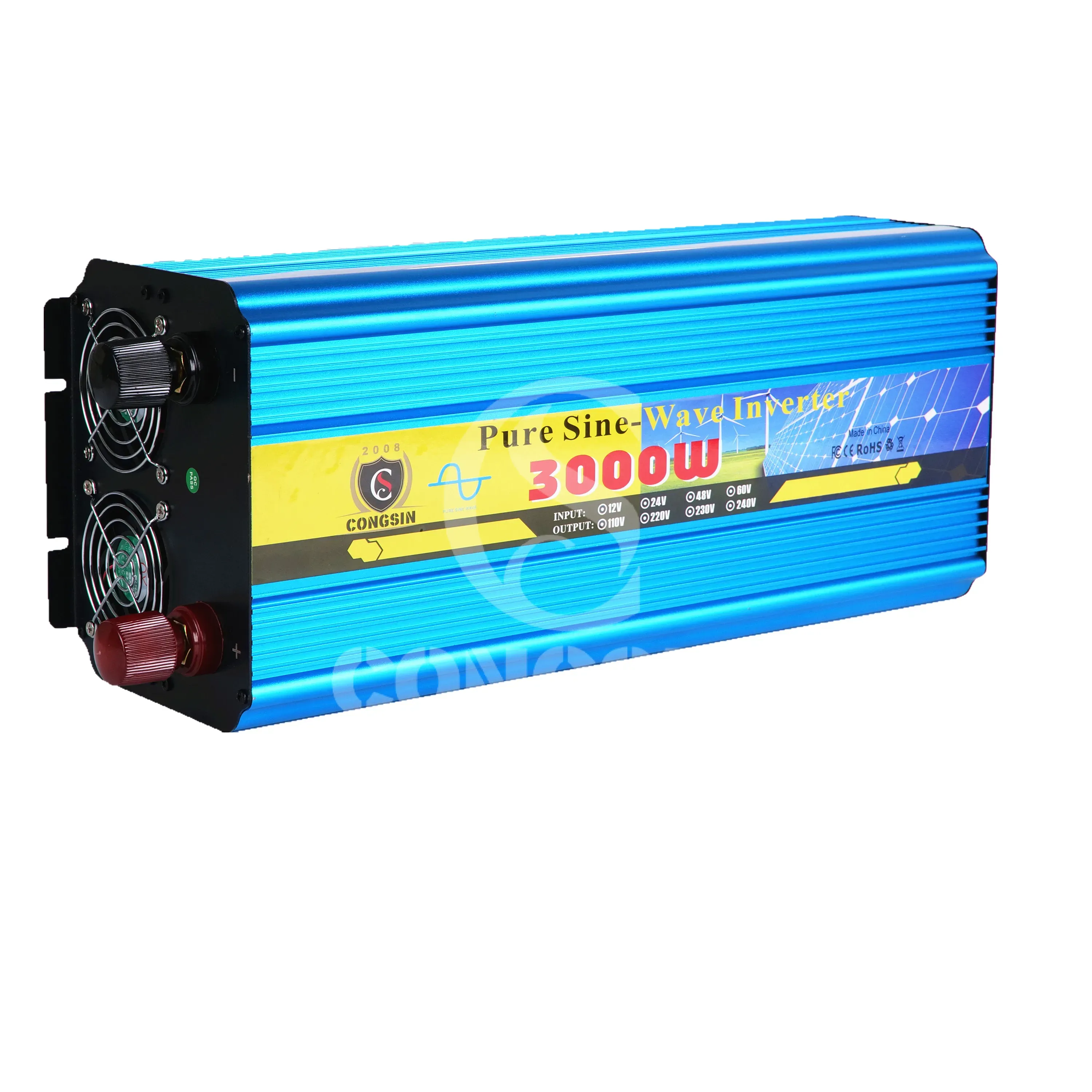
Congsin 3000W LCD Pure Sine Wave Inverter for Home Use Solar Backup Power Inverter Off Grid UPS
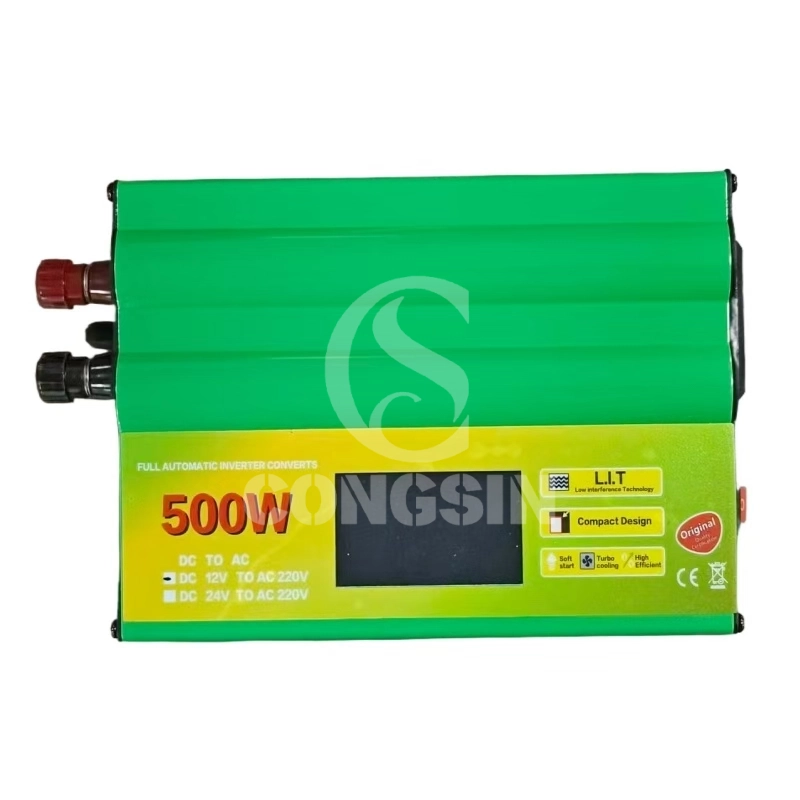
Congsin Modified Sine Wave Inverter 500W 1000W 1500W 12V LED Display Portable for RV Car Solar
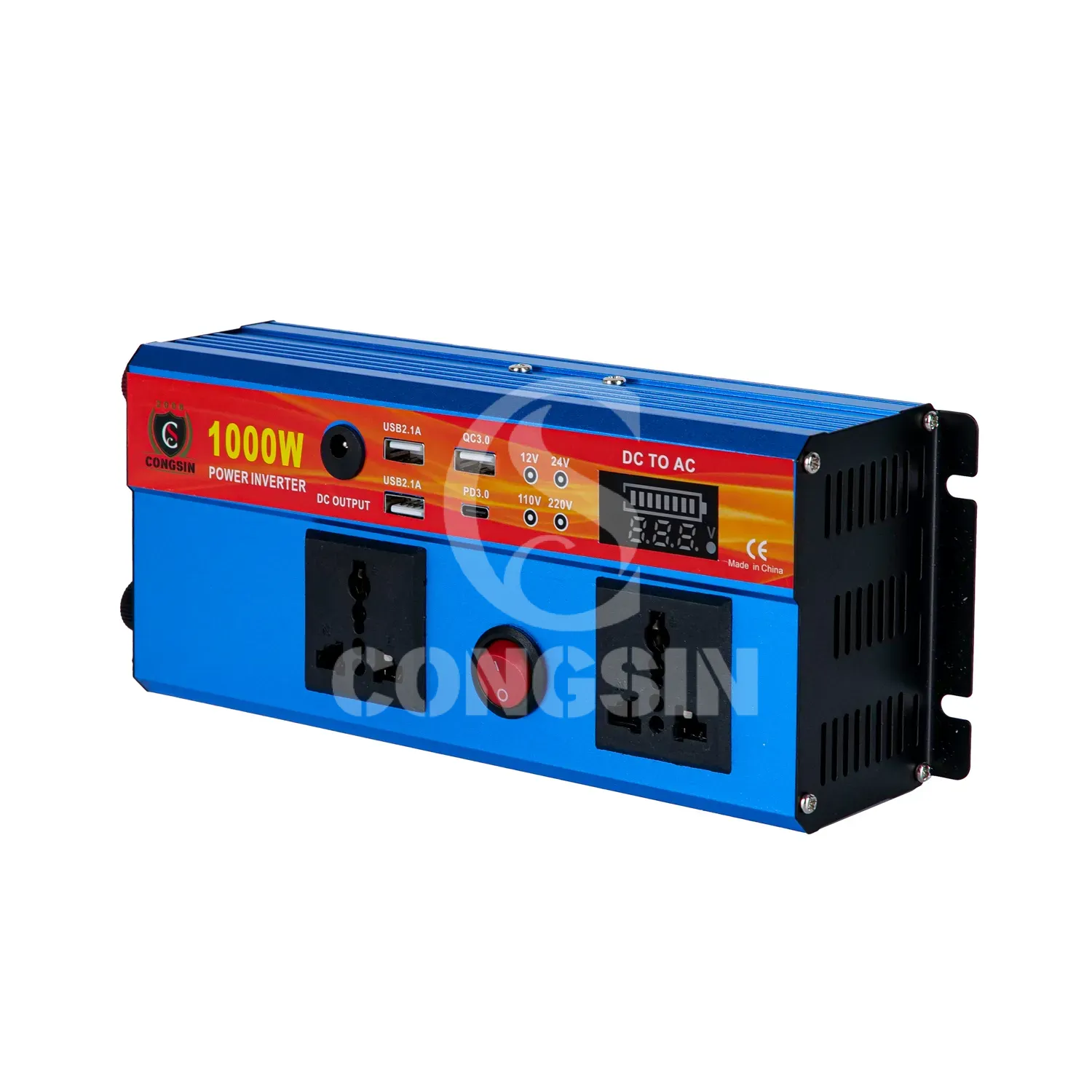
Congsin 1000W modified sine wave inverter with LED display and Type C port car RV power inverter
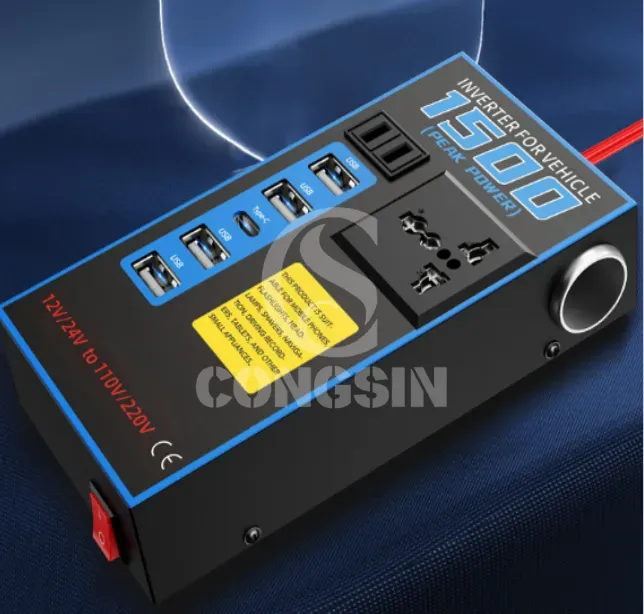
Congsin 1500W Inverter for Vehicle DC 12V/24V to AC 110V/220V with Universal socket Modified Sine Wave

CONGSIN is a trusted OEM factory for power inverters, solar charge controllers, and DC converters. Reliable solutions for global B2B buyers.
 High Quality
 7/24 Service
 Guaranteed Warranty
© 2025 Congsin. All Rights Reserved.